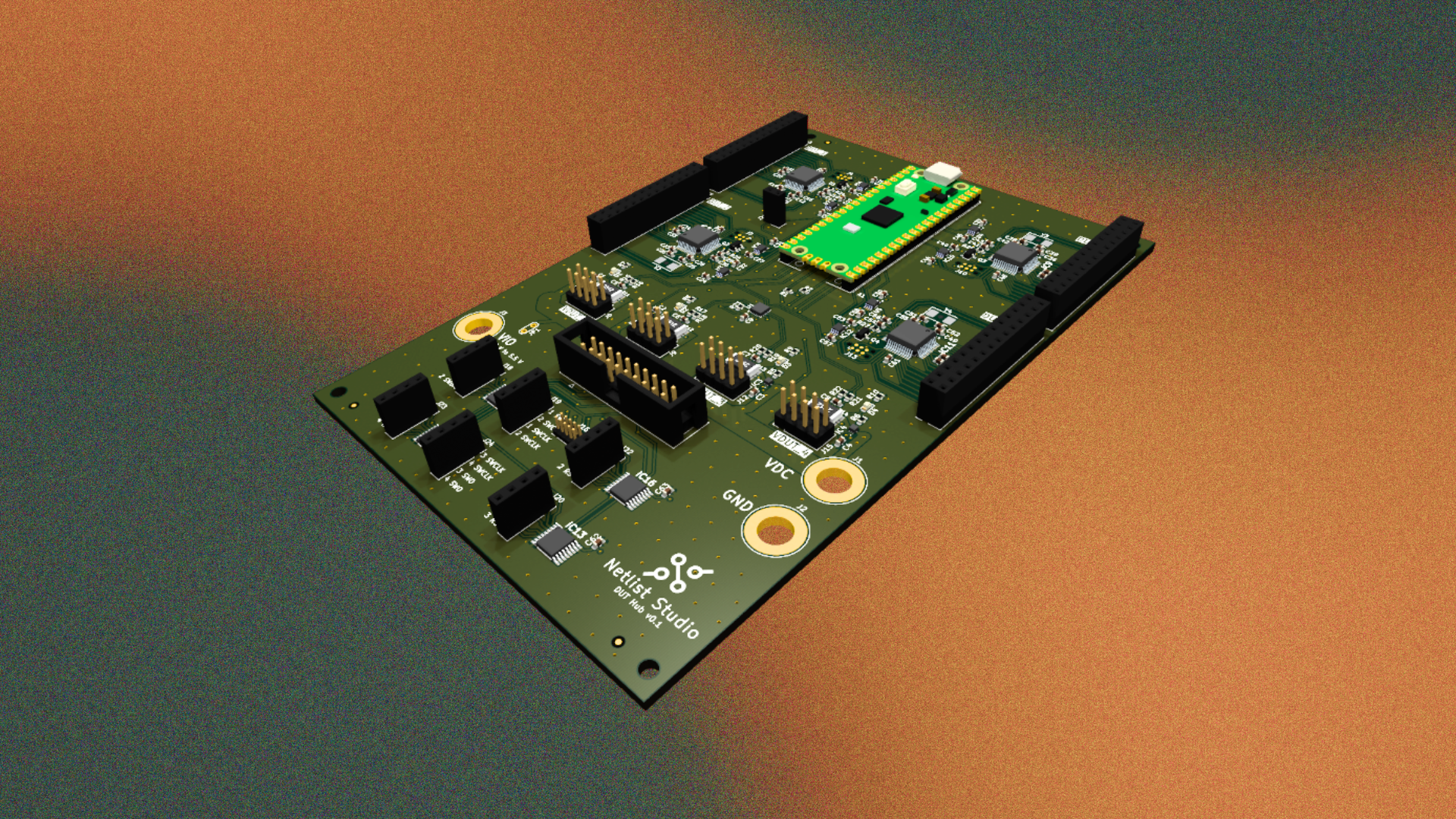
If you’ve ever had to flash and verify a batch of PCBs by hand, you know how quickly the process becomes a bottleneck. While high-end factories use "bed of nails" fixtures that cost thousands of dollars, there isn't much of a middle ground for solo developers or small shops.
The DUT Hub (Device Under Test Hub) is my attempt to bridge that gap. It’s an open-source, 4-channel automated test solution designed to handle power control, flashing, and testing for four independent devices.
The Hardware
The goal for V0.1 was to keep the BOM simple while maintaining maximum flexibility for different logic levels.
The Controller: I’m using a Raspberry Pi Pico as the primary interface. By taking advantage of its ability to expose multiple USB endpoints, I was able to create five independent serial ports. One for general control and one for each device under test. This approach allowed me to skip expensive dedicated USB-to-serial chips. Have you seen how expensive FTDI chips are?
The Tester Nodes: Each channel is powered by a Renesas RA4M1. I chose this specifically for its wide input voltage range (1.8V to 5V). This allows the hub to interface with a variety of target boards without needing external level shifters.
The Software
A simple command line interface is used to control each DUT. I've added commands to set/get GPIOs and read ADC channels. This is where the focus of the work will be going forward.
Checkout the video for live demo.